The Ultimate Guide to E-Commerce Marketing: Strategies to Skyrocket Online Sales
Introduction: –
The Transformative Power of Strategic E-Commerce Marketing. The global e-commerce landscape has undergone a seismic shift in recent years, with projections indicating that online sales will exceed $7.8 trillion by 2026. In this hyper-competitive digital marketplace, having a great product is no longer enough. Either You should Start E-Commerce Marketing or Dropshipping. Success demands a sophisticated, multi-channel e-commerce marketing strategy that attracts the right customers, converts them into buyers, and transforms them into loyal brand advocates.
E-Commerce Marketing encompasses all the digital strategies and tactics used to promote online stores, drive qualified traffic, increase conversions, and build lasting customer relationships. Unlike traditional retail marketing, e-commerce marketing operates in a measurable, data-driven environment where every click, view, and purchase can be tracked, analyzed, and optimized.
This comprehensive guide will take you from foundational principles to advanced execution, providing you with the complete framework needed to build, implement, and scale a winning e-commerce marketing strategy in 2026 and beyond.
Chapter 1: The Fundamental Benefits of Strategic E-Commerce Marketing
Why E-Commerce Marketing is Non-Negotiable for Online Success?
The Staggering Statistics: Understanding the E-Commerce Landscape
Before diving into strategies, it’s crucial to understand the market context:
*Global e-commerce sales grew by 18.1% in 2026, reaching approximately $6.5 trillion.
*Mobile commerce now represents 72.9% of all e-commerce sales.
*The average e-commerce conversion rate across industries is 2.86%, with top performers achieving 5-10%.
*Cart abandonment rates average 69.57%, representing a massive opportunity for recovery strategies.
*Customer acquisition costs have increased by 60% in the last five years, making retention more critical than ever.
1. Precise Targeting and Segmentation
Modern e-commerce marketing tools allow you to target customers based on demographics, interests, behavior, and purchase history with surgical precision. This ensures your marketing budget is spent reaching people most likely to convert.
2. Measurable ROI and Data-Driven Decisions
Every aspect of e-commerce marketing is trackable. You can calculate exact return on investment (ROI) for each channel, campaign, and even individual product, enabling continuous optimization.
3. Global Reach with Localized Personalization
You can reach customers worldwide while delivering personalized experiences based on location, language, preferences, and browsing behavior.
4. 24/7 Selling Capability
Unlike physical stores, your e-commerce marketing works around the clock, capturing sales across time zones and outside traditional business hours.
5. Scalability and Flexibility
Digital campaigns can be scaled up or down based on performance, seasonality, or inventory levels with minimal lag time.
Chapter 2: The 7-Pillar E-Commerce Marketing Framework
A successful e-commerce marketing strategy rests on seven interconnected pillars. Neglecting any one can undermine your entire effort.
Pillar 1: Search Engine Optimization (E-Commerce SEO)
E-commerce SEO ensures your products appear when potential customers search for them. With *53.3% of all website traffic coming from organic search, this is your most valuable sustainable traffic source.
*Step-by-Step E-Commerce SEO Implementation:
Step 1: Comprehensive Keyword Research
– Identify buyer-intent keywords using tools like Ahrefs, SEMrush, or Moz
– Focus on three keyword types:
1. Navigational keywords (branded searches)
2. Informational keywords (problem-awareness searches)
3. Commercial investigation keywords (comparison searches)
4. Transactional keywords (ready-to-buy searches)
Table: E-Commerce Keyword Strategy by Funnel Stage
| Funnel Stage | Keyword Intent | Example Keywords | Content Type |
| Awareness | Informational | “How to choose running shoes” | Blog guides, buying guides |
| Consideration | Commercial | “Best trail running shoes 2026” | Comparison pages, product roundups |
| Decision | Transactional | “Salomon Speed cross 5 women’s size 8” | Product pages, category pages |
| Loyalty | Navigational | “Salomon official store” | Brand pages, loyalty program |
Step 2: On-Page Optimization
*Product titles: Include primary keyword, brand, model, attributes (60 characters max)
*Product descriptions: Unique, benefit-focused copy with secondary keywords (300+ words)
*Image optimization: Compressed files with descriptive alt text containing keywords
*URL structure: Clean, readable URLs with categories and product names
*Schema markup: Implement product schema to enhance search result appearances
Step 3: Technical SEO Foundation
*Site speed optimization: Aim for sub-3-second load times (Google’s Core Web Vitals)
*Mobile responsiveness: Ensure flawless mobile experience (72.9% of e-commerce is mobile)
*Site architecture: Logical category and subcategory structure
*Canonical tags: Prevent duplicate content issues
*XML sitemap: Regularly updated and submitted to Google Search Console
Step 4: Content Marketing Integration
– Create comprehensive buying guides related to your products
– Publish user-generated content and customer stories
– Develop “how-to” content that addresses customer pain points
– Implement a blog with consistent, valuable content publishing
Pillar 2: Pay-Per-Click Advertising (E-Commerce PPC)
While SEO builds long-term traffic, PPC delivers immediate results. The most effective e-commerce PPC combines several platforms:
Google Shopping Campaigns
*Visual advantage: Products appear with images, prices, and reviews
*High intent: Users see exactly what they’re searching for
*Best for: Products with clear visual appeal and competitive pricing
Google Search Ads
*Text-based ads targeting specific search queries
*Best for: Brand awareness, new product launches, and high-margin products
Social Media Marketing For E-Commerce
*Facebook/Instagram: Advanced targeting based on interests, behaviors, and lookalike audiences
*Pinterest: Ideal for visually appealing products with DIY or inspiration angles
*TikTok: Excellent for reaching Gen Z with authentic, creative content
Retargeting/Remarketing Campaign
*Site retargeting: Reach users who visited but didn’t purchase
*Email retargeting: Target subscribers across platforms
*Dynamic retargeting: Show specific products users viewed
Table: PPC Platform Selection Guide
| Platform | Best For | Average CPC | Conversion Rate | Primary Ad Format |
| Google Shopping | Product searches | $0.66 | 1.91% | Product listing ads |
| Facebook/Instagram | Brand discovery | $1.72 | 1.85% | Image/video feed ads |
| Visual inspiration | $1.50 | 1.5% | Promoted pins | |
| TikTok | Trend-driven products | Varies widely | Varies | In-feed video ads |
Pillar 3: Email Marketing Automation
Email marketing delivers the highest ROI of any marketing channel approximately $42 for every $1 spent. For e-commerce, it’s not just about promotional blasts; it’s about automated, personalized customer journeys.
Essential E-Commerce Email Sequences:
1. Welcome Series (3-5 emails)
– Email 1: Immediate welcome + discount incentive
– Email 2: Brand story/mission
– Email 3: Product highlights/best sellers
– Email 4: Social proof/testimonials
– Email 5: Reminder of expiring discount
2. Abandoned Cart Series (3 emails)
– Email 1: Sent 1 hour after abandonment (gentle reminder)
– Email 2: Sent 24 hours later (address potential objections)
– Email 3: Sent 48 hours later (urgency + final incentive)
3. Post-Purchase Series
– Order confirmation
– Shipping notification
– Delivery confirmation
– Product education/tips
– Review request (14 days post-purchase)
– Cross-sell recommendation (21 days post-purchase)
4. Re-Engagement Campaigns
– For inactive subscribers (90+ days)
– Special offers to reactivate
– Preference updates requests
Advanced Segmentation Strategies:
– Purchase history segmentation
– Behavioral segmentation (browsing patterns)
– Demographic segmentation
– Predictive segmentation (likely to churn, likely to buy)
Pillar 4: Social Commerce & Influencer Marketing
Social platforms are no longer just awareness channels—they’re becoming direct sales channels with the rise of social commerce.
Social Commerce Implementation Framework:
Step 1: Platform Selection
*Instagram: Shoppable posts, Instagram Checkout, Instagram Shops
*Facebook: Facebook Shops, Marketplace integration
*Pinterest: Buyable Pins, Product Pins
*TikTok: TikTok Shopping, LIVE shopping events
*YouTube: Shelf, shopping integrations in videos
Step 2: Content Strategy for Social Selling
*User-generated content (UGC): Encourage customers to share their purchases
*Behind-the-scenes content: Build brand authenticity
*Educational content: How to use your products
*Social proof: Customer reviews and testimonials
*Limited-time offers: Exclusive social promotions
Step 3: Influencer Partnership Tiers
Table: Influencer Marketing Strategy by Tier
| Influencer Tier | Follower Range | Best For | Compensation Range |
| Nano-influencer | 1K-10K | Niche targeting, authenticity | Product exchange – $500 |
| Micro-influencer | 10K-100K | Engagement, conversions | $500 – $5,000 |
| Macro-influencer | 100K-1M | Broad awareness | $5,000 – $50,000 |
| Mega-influencer | 1M+ | Mass brand awareness | $50,000+ |
Pillar 5: Conversion Rate Optimization (CRO)
Driving traffic is only half the battle. Converting visitors into customers requires systematic optimization.
The CRO Process Cycle:
1. Data Collection & Analysis
– Analytics review (Google Analytics 4)
– Heatmaps and session recordings (Hotjar, Crazy Egg)
– Customer surveys and feedback
– A/B testing results
2. Hypothesis Formation
– Identify specific problems (e.g., “Product page has high bounce rate”)
– Formulate potential solutions (e.g., “Adding video demonstrations will increase engagement”)
– Create testable hypothesis (e.g., “Adding product videos will increase add-to-cart rate by 15%”)
3. Testing Implementation
– A/B testing (two variations)
– Multivariate testing (multiple elements)
– Split testing (completely different pages)
4. Analysis & Implementation
– Statistical significance validation
– Winner implementation
– Documentation of learnings
Critical E-Commerce CRO Focus Areas:
Product Page Optimization:
– High-quality images (multiple angles, zoom functionality)
– Compelling benefit-focused copy
– Clear calls-to-action
– Social proof elements (reviews, ratings)
– Trust signals (security badges, return policies)
– Urgency and scarcity elements (when appropriate)
Checkout Optimization:
– Guest checkout option
– Minimal form fields
– Multiple payment options
– Progress indicator
– Shipping cost calculator early in process
– Mobile-optimized checkout
Site-Wide Trust Building:
– Clear contact information
– Detailed shipping and return policies
– Customer reviews and testimonials
– Security certifications
– Social media presence links
– Press mentions and media logos
Pillar 6: Content Marketing & Value Creation
Content marketing for e-commerce goes beyond blogging. It’s about creating valuable, relevant content that attracts and educates potential customers throughout their journey.
E-Commerce Content Matrix:
Table: Content Types by Marketing Objective
| Content Type | Primary Objective | Best Formats | Distribution Channels |
| Educational Guides | SEO, Authority | Blog posts, PDF guides | Blog, email, social snippets |
| Product Comparisons | Conversion | Comparison pages, videos | Product pages, YouTube |
| User-Generated Content | Social Proof | Photos, videos, reviews | Social media, product pages |
| How-To Tutorials | Engagement, Education | Video tutorials, step-by-step guides | YouTube, blog, Pinterest |
| Seasonal Content | Timely Relevance | Gift guides, holiday content | Blog, email campaigns, social |
| Behind-the-Scenes | Brand Building | Stories, live videos, employee features | Instagram, Facebook, TikTok |
Advanced Content Strategy: The Hub-and-Spoke Model
1. Pillar Content (Hub): Comprehensive, in-depth resource (e.g., “The Complete Guide to Home Coffee Brewing”)
2. Cluster Content (Spokes): Related articles targeting specific long-tail keywords (e.g., “French Press vs. Pour Over,” “Best Coffee Grinders Under $100”)
3. Internal Linking: Strategic links between cluster content and pillar page
4. Content Refresh: Regular updates to maintain relevance and SEO value
Pillar 7: Analytics, Measurement & Optimization
What gets measured gets improved. E-commerce marketing success depends on tracking the right metrics and making data-driven decisions.
Essential E-Commerce KPIs Dashboard:
Our Free KPI Tool And KPI Excel Sheet (Calculator)
Traffic Metrics:
– Total sessions
– Traffic sources (organic, direct, social, referral, email, paid)
– New vs. returning visitors
– Geographic distribution
Conversion Metrics:
– Conversion rate
– Average order value (AOV)
– Revenue per visitor
– Shopping cart abandonment rate
– Checkout completion rate
Customer Metrics:
– Customer lifetime value (CLV)
– Customer acquisition cost (CAC)
– Purchase frequency
– Repeat purchase rate
– Churn rate
Product Performance:
– Units sold per product
– Revenue per product
– Product page conversion rate
– Return rate by product
Analytics Implementation Checklist:
– Google Analytics 4 properly configured with e-commerce tracking
– Conversion goals set up for key actions
– Enhanced e-commerce tracking implemented
– UTM parameters used consistently for campaign tracking
– Google Search Console connected and monitored
– Product performance reporting automated
– Customer segmentation available in analytics
– Regular reporting schedule established
Chapter 3: The Integrated E-Commerce Marketing Funnel
Successful e-commerce marketing requires aligning strategies with the customer journey. Here’s how to map tactics to each funnel stage:
Stage 1: Awareness (Top of Funnel)
*Objective: Introduce your brand to potential customers
*Primary Channels: SEO (informational keywords), social media, content marketing, influencer partnerships
*Key Metrics: Reach, impressions, brand searches, social engagement
*Content Focus: Educational, entertaining, problem-awareness content
Stage 2: Consideration (Middle of Funnel)
*Objective: Position your products as the best solution
*Primary Channels: Retargeting ads, email nurturing, comparison content, webinars
*Key Metrics: Click-through rate, engagement rate, time on site, pages per session
*Content Focus: Product comparisons, case studies, expert reviews, demonstration videos
Stage 3: Conversion (Bottom of Funnel)
*Objective: Drive the purchase decision
*Primary Channels: Google Shopping, search ads (transactional keywords), email promotions, on-site optimization
*Key Metrics: Conversion rate, cost per acquisition, return on ad spend
*Content Focus: Product pages, testimonials, limited-time offers, free shipping promotions
Stage 4: Retention & Advocacy (Post-Purchase)
*Objective: Turn customers into repeat buyers and brand advocates
*Primary Channels: Email marketing, loyalty programs, referral programs, social communities
*Key Metrics: Customer lifetime value, repeat purchase rate, net promoter score, referral rate
*Content Focus: Post-purchase education, exclusive offers, user-generated content prompts
Chapter 4: Advanced E-Commerce Marketing Strategy for 2026
Strategy 1: Personalization at Scale
Modern consumers expect personalized experiences. Implement these tactics:
AI-Powered Product Recommendations:
– “Frequently bought together” suggestions
– “Customers who viewed this also viewed” recommendations
– Personalized “For You” sections based on browsing history
Dynamic Website Content:
– Homepage banners based on visitor source
– Category page sorting based on user behavior
– Personalized promotions based on purchase history
Segmented Email Campaigns:
– Birthday/anniversary offers
– Back-in-stock notifications for previously viewed items
– Browse abandonment sequences
Strategy 2: Omnichannel Integration
Break down silos between channels for a seamless customer experience:
*Buy online, pick up in store (BOPIS): Implement and promote
*Social media to website: Smooth transition from social posts to product pages
*Email to mobile app: Deep linking from emails to specific app screens
*Offline to online: QR codes in physical locations driving to digital experiences
Strategy 3: Voice Commerce Optimization
With 35% of US households owning smart speakers, voice commerce is growing:
– Optimize for voice search (natural language, question-based queries)
– Develop Alexa Skills or Google Actions for your brand
– Ensure your business information is consistent across voice platforms
Strategy 4: Sustainability and Ethical Marketing
73% of consumers would change their consumption habits to reduce environmental impact:
– Highlight sustainable practices in your marketing
– Offer carbon-neutral shipping options
– Develop recycling or take-back programs
– Be transparent about your supply chain
Chapter 5: Building Your E-Commerce Marketing Technology Stack
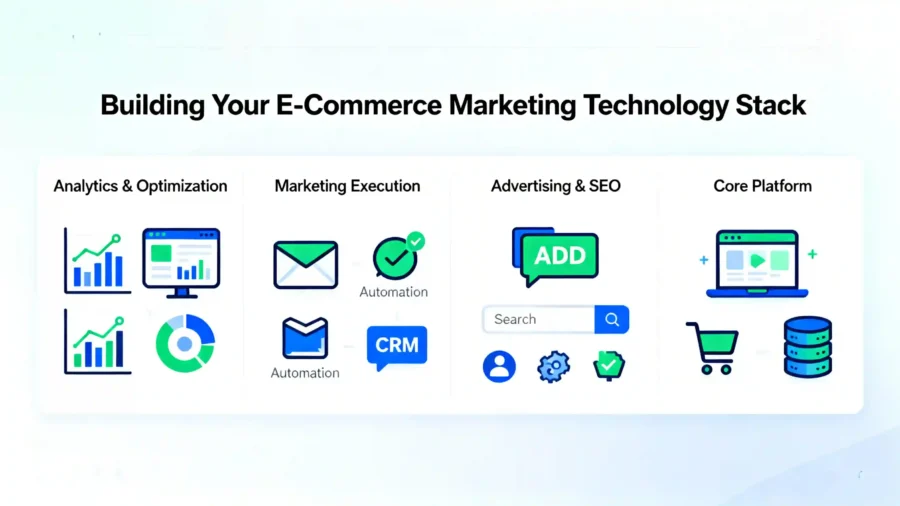
The right tools make execution efficient and effective. Here’s a recommended stack by category:
Core Platform:
*E-commerce Platform: Shopify Plus, BigCommerce, Adobe Commerce (Magento)
*CRM: HubSpot, Klaviyo (e-commerce specialized), Salesforce Commerce Cloud
Marketing Execution:
*Email Marketing: Klaviyo, Omnisend, Mailchimp
*Social Media Management: Buffer, Hootsuite, Sprout Social
*Content Management: WordPress, Contentful
Analytics & Optimization:
*Web Analytics: Google Analytics 4, Adobe Analytics
*Heatmaps & Recordings: Hotjar, Crazy Egg, Microsoft Clarity
*A/B Testing: Optimizely, VWO, Google Optimize
Advertising & SEO:
*PPC Management: Google Ads, Microsoft Advertising, Smartly.io
*SEO Tools: Ahrefs, SEMrush, Moz Pro
*Shopping Feed Management: Feedonomics, DataFeedWatch
Table: Budget-Based Technology Stack Recommendations
| Business Stage | Monthly Budget | Recommended Stack | Estimated Monthly Cost |
| Startup | $100-$500 | Shopify Basic, Mailchimp Free, Google Analytics | $29 + free tools |
| Growth | $500-$2,000 | Shopify Plus, Klaviyo, Ahrefs, Hotjar | $300-$800 |
| Established | $2,000-$10,000 | BigCommerce Enterprise, HubSpot, Optimizely, full stack | $2,000-$5,000 |
| Enterprise | $10,000+ | Adobe Commerce, Salesforce, enterprise tools | Custom pricing |
Chapter 6: Common E-Commerce Marketing Pitfalls and How to Avoid Them
Pitfall 1: Neglecting Mobile Optimization
*The Problem: 72.9% of e-commerce is mobile, but many sites still offer poor mobile experiences.
*The Solution: Implement mobile-first design, optimize checkout for mobile, test across devices regularly.
Pitfall 2: Focusing Only on Acquisition
*The Problem: Overemphasis on new customers while ignoring existing ones.
*The Solution: Balance budget between acquisition (40%), retention (40%), and reactivation (20%).
Pitfall 3: Inconsistent Brand Messaging
*The Problem: Different channels present different brand voices and values.
*The Solution: Create comprehensive brand guidelines and ensure all teams follow them.
Pitfall 4: Ignoring Customer Feedback
*The Problem: Not listening to what customers actually want.
*The Solution: Implement systematic feedback collection (surveys, reviews, social listening) and act on insights.
Pitfall 5: Analysis Paralysis
*The Problem: Collecting data but not making decisions.
*The Solution: Establish clear reporting cadence with action-oriented insights.
Conclusion: Building Your Action Plan
E-commerce marketing success doesn’t happen by accident. It results from a strategic, integrated approach executed consistently over time. As we move through 2026, the most successful e-commerce brands will be those that:
1. Master the fundamentals of SEO, email, and conversion optimization
2. Embrace emerging channels like social commerce and voice search
3. Prioritize personalization at every touchpoint
4. Focus on customer lifetime value rather than single transactions
5. Remain agile and data-driven in their decision-making
Your 90-Day E-Commerce Marketing Implementation Plan:
Weeks 1-4: Foundation & Audit
– Conduct complete website and marketing audit
– Set up or optimize analytics tracking
– Define target customer personas
– Establish key performance indicators
Weeks 5-8: Core Strategy Implementation
– Implement SEO improvements based on audit
– Set up essential email automation sequences
– Launch or optimize 1-2 key advertising campaigns
– Begin A/B testing program
Weeks 9-12: Optimization & Scaling
– Analyze initial results and double down on what works
– Expand to additional marketing channels
– Implement advanced personalization
– Develop content calendar for next quarter
Remember: E-commerce marketing Strategy is not a set-it-and-forget-it endeavor. It requires continuous testing, learning, and optimization. The landscape evolves rapidly, with new platforms, technologies, and consumer behaviors emerging constantly. Stay curious, stay data-driven, and stay focused on delivering exceptional value to your customers.
Final Takeaway:
The most sustainable competitive advantage in e-commerce isn’t just having the best products or the lowest prices—it’s building the deepest, most valuable relationships with your customers through exceptional marketing experiences. Start where you are, use what you have, implement one strategy at a time, and consistently measure and improve. Your e-commerce success story starts today.
People Also Ask:
What is an e-commerce marketing strategy?
A plan that uses online channels (SEO, social media, email, ads) to attract visitors, convert them into customers, and retain them for an online store.
What is the 3 3 3 rule in marketing?
A social media content framework: Post 3 daily stories, engage with 3 relevant posts, and spend 3 minutes commenting to boost visibility and community.
What are the 7 steps of E-Commerce marketing strategy?
1. Situation Analysis (SWOT)
2. Define Goals
3. Identify Target Audience
4. Research Competition
5. Develop Marketing Mix (4Ps: Product, Price, Place, Promotion)
6. Implement Plan
7. Monitor, Measure, Adjust
What are the 5 C’s of e-commerce?
1. Company: Your goals, capabilities, brand.
2. Customers: Target audience needs/behaviors.
3. Competitors: Their strengths/weaknesses.
4. Collaborators: Partners (suppliers, influencers).
5. Climate: Market, tech, socio-economic, legal environment.
Frequently Asked Questions (FAQ)
1. What is the best way to start marketing my new e-commerce store?
The most effective way to begin is by implementing the “Foundation First” approach outlined in our guide. Don’t try to do everything at once. Start with these 4 critical steps:
1. Install & Configure Analytics: Immediately set up Google Analytics 4 with e-commerce tracking. You can’t improve what you don’t measure.
2. Master On-Site SEO: Before driving paid traffic, ensure your store is search-engine friendly. Optimize all product pages with unique titles, descriptions, and image alt text. Build a logical site structure.
3. Launch a Basic Email Flows: Set up automated welcome and abandoned cart email sequences. This is your highest-ROI channel from day one.
4. Run a Focused Paid Campaign: Start with a single, well-targeted campaign, such as Google Shopping for specific products or a Facebook engagement campaign to build your audience. Use the data from your analytics to inform your strategy.
2. How much should I budget for e-commerce marketing?
There’s no one-size-fits-all number, but a standard rule of thumb is to allocate 10-15% of your projected gross revenue to marketing. How you distribute that budget depends on your business stage (refer to the Technology Stack table in the guide)
Startups (Pre-Revenue/Few Sales): Focus on low-cost channels. Budget for essential tools (e.g., Shopify, email platform) and a small testing budget for PPC/Social Ads ($500-$2,000/month). Prioritize content and SEO.
Growth Stage ($10k-$100k/month revenue): Increase investment in proven channels. A common split is 40% on Acquisition (Paid Ads, Influencers), 40% on Retention (Email Marketing, Loyalty Programs), and 20% on Brand & Content.
Established Brands ($100k+/month revenue): Budget becomes more complex and scaled. Significant investment in advanced technology, a full marketing team, and omnichannel campaigns is typical.
3. What are the quickest ways to increase e-commerce sales?
For immediate impact, focus on conversion rate optimization (CRO) and retargeting:
Optimize Your Product Pages: Add high-quality videos, improve copy to highlight benefits (not just features), display trust badges, and ensure reviews are visible. This can yield results in days.
Launch Retargeting Campaigns: Set up ads on Google and Facebook to follow users who visited your site but didn’t buy. This targets “warm” audiences with a higher intent to purchase.
Create Urgency & Scarcity: Implement countdown timers for sales or show low-stock notifications on high-intent product pages.
Optimize Checkout: Offer multiple payment options (especially digital wallets like Apple Pay), enable guest checkout, and reduce form fields. This can directly reduce cart abandonment.